
How important is winning a faceoff in hockey?

I have been long fascinated with the discourse around faceoffs in hockey. Namely, whether or not winning a faceoff contributes to a team’s overall likelihood of winning a game. Traditionalists will stress the importance of faceoffs and those in front offices often prioritize the acquisition of players with a talent for winning them. More progressive hockey fans and pundits have pushed back against this stating that faceoff taking is an overrated skill and that the impact of winning the faceoff is greatly overstated. People in the hockey analytics space have previously attempted to decipher the faceoff and its value.
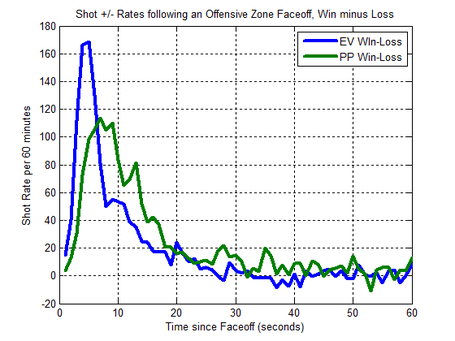
Gabriel Desjardins looked at the impact of winning an offensive zone faceoffs on shot rates in the minute. The results of his study are shown in the graph below. A faceoff win was associated with an increase in shot rate in the first 20 seconds after the faceoff before the impact on shot rate plateaued at zero. Using average shooting percentages Desjardins calculated that this initial bump was worth 2.45 goals per 100 faceoff wins at even strength and 3.66 goals per 100 faceoff wins on the powerplay. This led him to conclude that winning faceoffs is beneficial but to a marginal degree that it likely does not have an impact on the outcome of the game
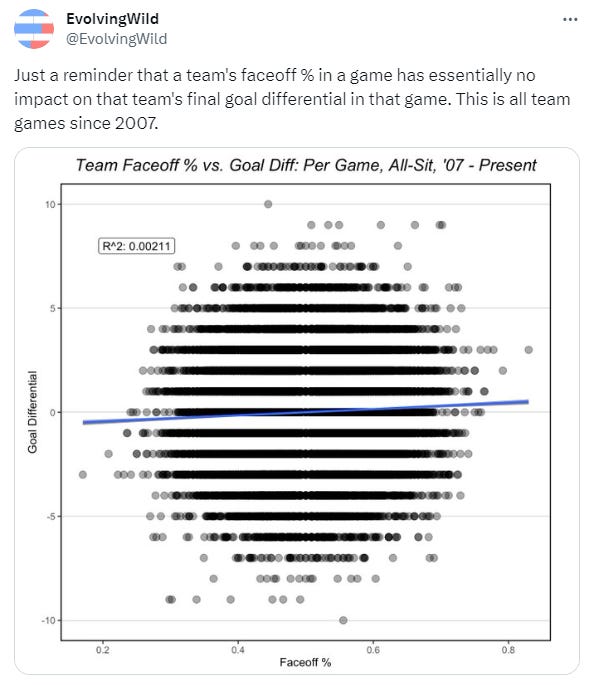
The Evolving Wild twins, creators of evolving-hockey.com, demonstrated that there was no correlation between a team’s faceoff percentage and their goal differential in a particular game.
I was still intrigued by this question and wanted to see the direct impact of winning a faceoff on a team’s ability to score a goal. To do so, I turned to survival analysis, which is used frequently in epidemiology and clinical science to estimate the probability of an individual surviving (or conversely, dying) and comparing that probability across treatment or exposure groups. This can be applied to any binary outcome where we care about the “time to event.” Time to event analysis is neatly depicted by Kaplan Meier curves which plot the estimated probability of surviving(or not experiencing an event) to given time. These can be inverted to show the cumulative probability of dying (or experiencing an event) at a given time.
In this analysis I used Dan Morse’s hockeyR package to scrape play by play data from every game in the 2021-22 and 2022-23 NHL seasons. I broke up the game data into “stints”, units of time that begin with a faceoff and end with a stoppage in play or after 120 seconds have elapsed. Each stint was analysed twice, once from the perspective of the home team and again from the perspective of the away team. The main exposure of interest here is whether or not the given team won the faceoff and the outcome being if the stint ended with that team scoring a goal.
Overall there were 156 700 stints over the two seasons. There were 80 084 Home faceoff wins, 76 686 Away faceoff wins, 7 228 Home goals and 6 762 away goals.
First I plotted the cumulative probability of scoring a goal in the first two minutes after a faceoff for both home and away teams.
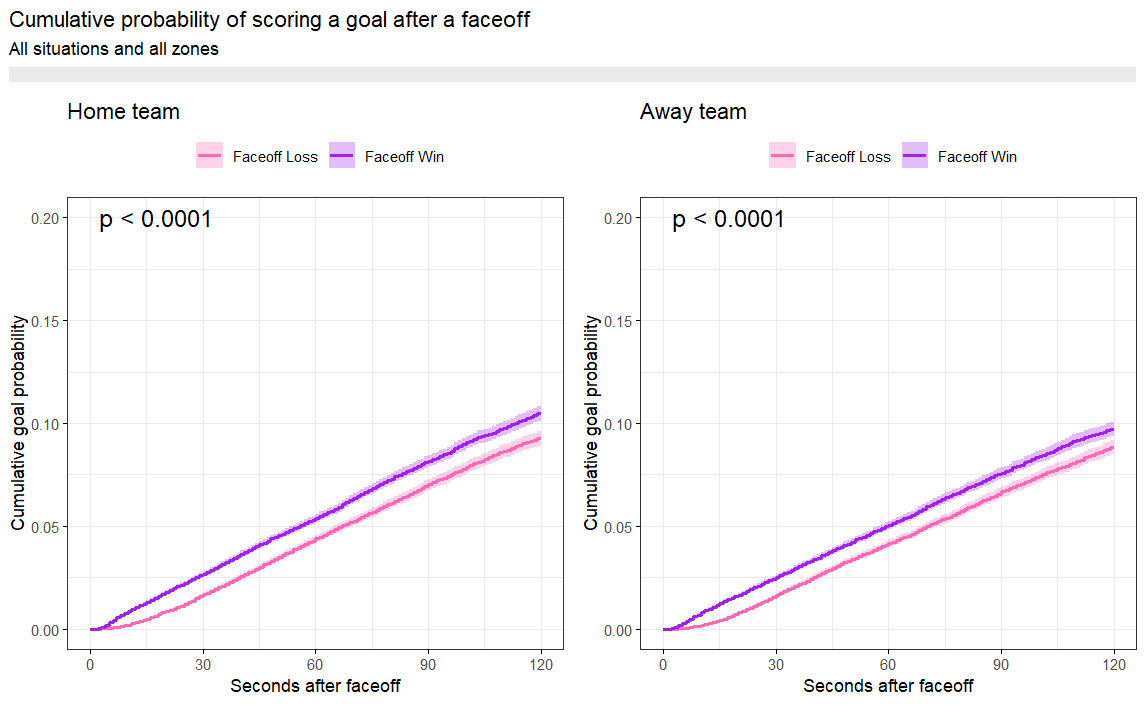
From this graph, we can see that winning a faceoff clearly increases a team’s likelihood of scoring a goal. However the difference at the end of two minutes is only around 1 percentage point.
Not all faceoffs are equal and I wanted to see the impact of winning faceoff by strength state and location of the faceoff. The two graphs below show the cumulative probability of scoring a goal after winning or losing a faceoff. The shaded area around the lines represents the confidence interval for the estimated cumulative probability at a given time. Roughly speaking, if there is a lot of overlap between the shaded areas, then it is likely that difference between them is not significant.
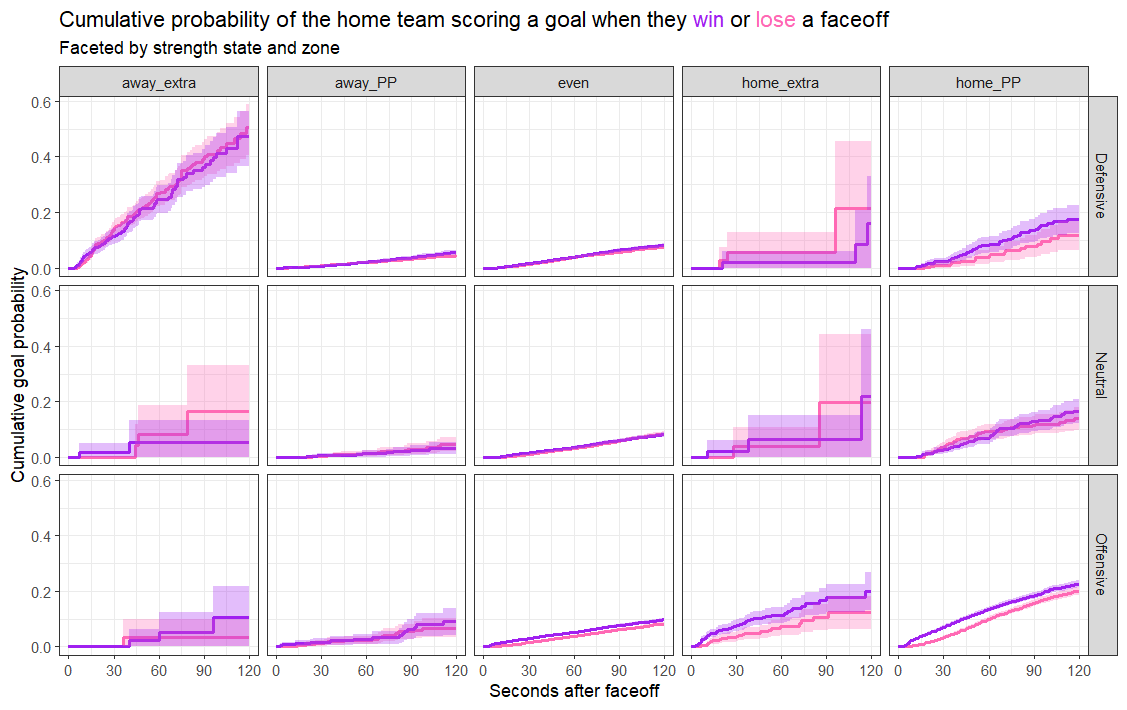
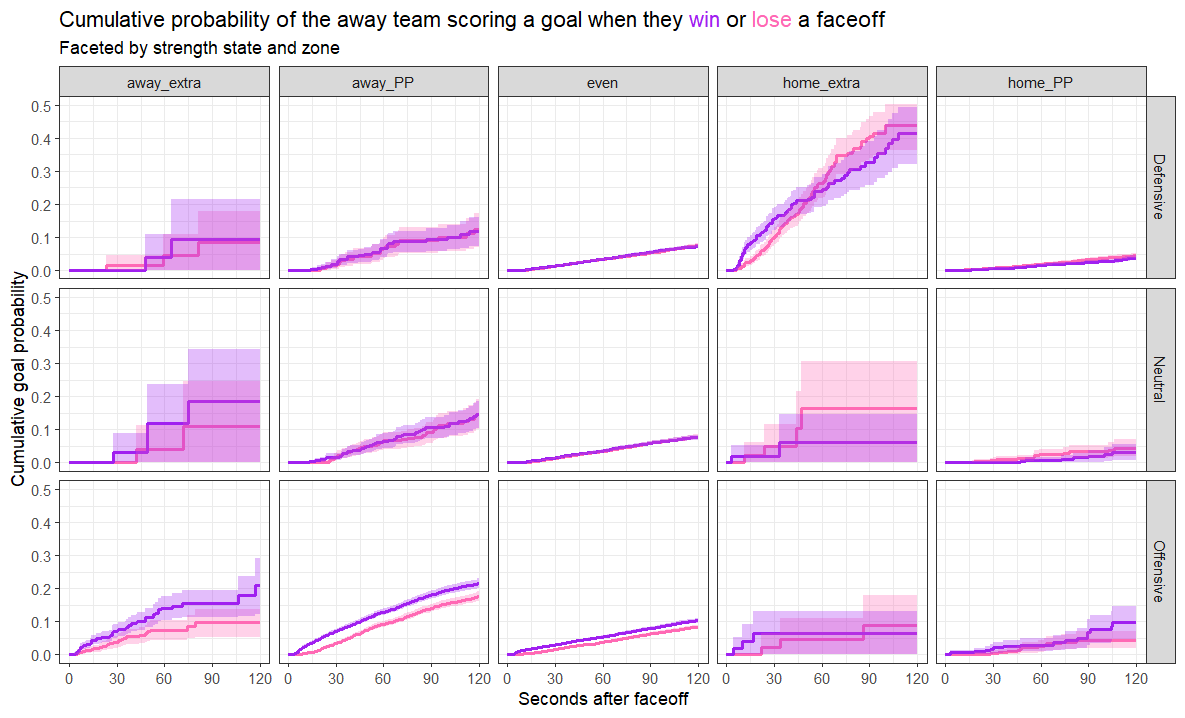
The takeaways from these analyses are:
When the other team has the goalie pulled(away_extra for home and home_extra for the away perspective), winning the faceoff is not particularly advantageous as I previously thought
When on the powerplay, winning the faceoff is associated with an increase in goal probability but only for offensive zone draws.
At even strength, only winning offensive zone draws increases your chances of scoring a goal but this increase is quite small.
When a team has the extra attacker, like on the powerplay, winning an offensive zone faceoff is beneficial for scoring that tying goal.
Faceoff wins do lead to an increase in probability of scoring a goal in certain situations and aren’t as unimportant as some people in the analytics sphere might think. However, the magnitude of the difference in goal probability is on the scale of a few percentage points so prioritizing faceoff talent over other skillsets is probably not advisable.